

Saucony's Trail Personality
Saucony carries a road-running emphasis on responsive transitions into a trail range that generally feels athletic rather than bulky. The brand is strongest for runners who want to place feet quickly and sense terrain without giving up protection entirely. Its model families stretch from accessible hybrids to plated or speed-driven race tools, so Peregrine should be treated as the center, not the complete identity. Saucony can feel immediately familiar to road runners, although trail fit must control more lateral and downhill force. The lineup becomes useful when organized by duration and surface: Peregrine for mixed daily trail, Xodus Ultra for long protection, ST variants for soft ground, Blaze Trail for hybrid routes, Excursion for uncomplicated utility, and Endorphin families for pace. Each branch has a reason not to buy it as well as a reason to choose it.
Peregrine: Agile Everyday Trail
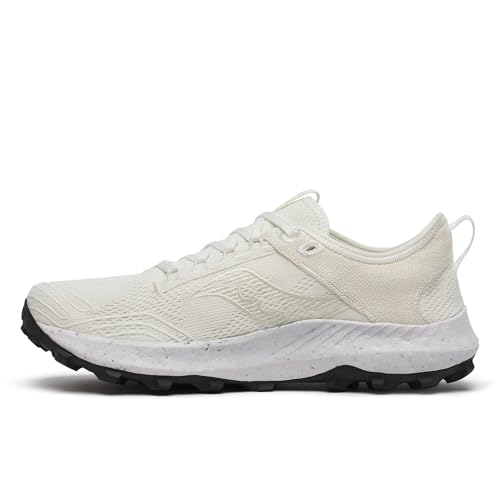
Peregrine is the model most likely to define a runner's view of Saucony off-road. It combines meaningful grip with an agile platform that preserves trail feedback. Climbs, corners, and mixed singletrack suit its active personality. Runners coming from responsive road shoes may appreciate that it does not turn every dirt run into a slow protected cruise. The tradeoff becomes clear over relentless rock or very long distance, where some athletes will want a deeper cushion. Fit should remain secure without crushing the forefoot, particularly during sidehill movement. Peregrine is a sound daily choice for runners who enjoy controlling the run through foot placement. It is less appropriate for someone whose primary need is to stop feeling sharp ground or whose trails are consistently deep mud rather than an ordinary mixture.
Peregrine ST: A Terrain Change, Not a Cosmetic Variant
The soft-ground Peregrine variant deserves separate treatment because deeper, more open lugs change the intended surface. It is for mud, loose soil, and conditions where the standard outsole cannot reach through the upper layer effectively. On firm hardpack and pavement links, that extra structure can feel pronounced and may be unnecessary. Buyers should count muddy miles before choosing it. One wet event each year does not necessarily justify a specialist in the daily rotation. Upper security and debris management also matter because traction is lost when the foot moves inside the shoe. Confirm the current suffix and product page rather than assuming every retailer labels the variant consistently. The ST belongs beside the standard Peregrine in a brand hub to help readers choose the right surface tool, not as a more aggressive universal upgrade.
Continue this topic: Altra Lone Peak vs Saucony Peregrine: Toe Room or Trail Precision?.
Xodus Ultra: Protection for Time on Feet
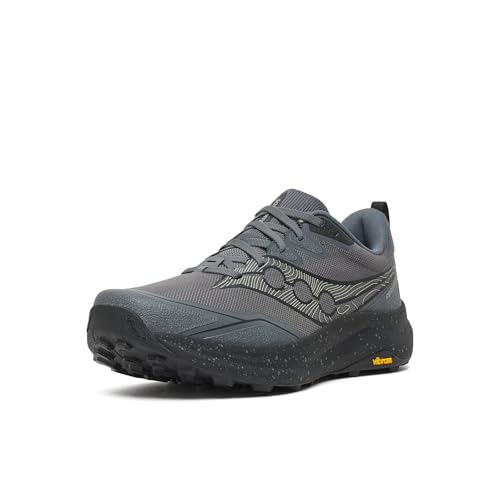
Xodus Ultra addresses the runner who likes Saucony but needs more cushion and protection as hours accumulate. Its role includes ultramarathon training, long mountain days, and steady trail cruising where late-run comfort matters more than the Peregrine's quick ground conversation. That extra platform can reduce repeated impact, yet it also changes handling. Runners should test whether the shoe feels controlled on off-camber ground and whether the upper prevents movement during descents. Xodus Ultra is not automatically the best Saucony for every ultra. Runnable courses and pace goals may reward an Endorphin model; short technical races may still favor Peregrine. Choose Xodus when the specific failure in other shoes is underfoot fatigue, not simply because the route has a large distance number attached to it.
Endorphin Trail Options: Speed with Conditions
Saucony uses the Endorphin name for performance-led trail shoes, including models designed around efficient transitions and race pace. The exact families and constructions should be confirmed for the current season because performance ranges evolve. The durable buying principle is to match propulsion to a runnable course and the runner's mechanics. A plate or rocker can help maintain rhythm, but technical rock, steep hiking, and slow late-race movement may expose awkwardness that never appears on a smooth test path. Race shoes often use close uppers to hold the foot at speed; swelling and downhill toe clearance remain essential. Choose an Endorphin trail model because it performs at goal pace on representative terrain. Do not treat the name as proof that it is more capable than Xodus or Peregrine in every condition.
Blaze Trail and Excursion TR: Practical Access
Blaze Trail suits mixed routes and runners who want a comfortable bridge between road and moderate dirt. It is useful when the run begins on pavement and reaches gravel, park paths, or easy singletrack without severe rock. Excursion TR occupies a straightforward utility role for entry-level trail, walking, and uncomplicated outdoor use. These families make Saucony accessible without requiring race technology or a highly specialized outsole. Their boundary is technical demand. Sustained sharp ground, deep mud, and fast descending may justify moving to Peregrine or Xodus. A practical model is not inferior when it matches the route; it is often more comfortable because the outsole and upper are not overbuilt. Compare use, fit, and surface rather than framing the decision around retail tiers or temporary discounts.
Fit, Cushion, and Rotation Logic
Saucony trail shoes can feel secure and performance-shaped, so runners needing forefoot room should verify current widths and toe-box taper. The heel must remain seated during braking, but tightening laces until the instep aches is not proper lockdown. Try the shoe later in the day with normal socks and walk on an incline. Cushion should be selected by terrain and recovery needs rather than treated as a quality scale. Peregrine and Xodus can form a useful rotation: the first for active daily trail and the second for long protected efforts. An Endorphin model can add race specificity, while Blaze handles mixed access. Rotation is optional, but it illustrates the lineup's logic. A runner owning one pair should choose the model that solves the majority of weekly miles, not the rarest future event.
Final Verdict
Saucony is a compelling trail brand for runners who like responsive movement and want clear routes toward grip, distance, or speed. Peregrine is the versatile agile anchor, Peregrine ST handles recurring soft ground, Xodus Ultra protects long outings, Endorphin trail models pursue racing efficiency, and Blaze Trail or Excursion TR cover less technical access. The brand is less automatic for runners wanting an extremely anatomical forefoot or the tallest possible cushion. Begin with the normal trail surface, then decide how much feedback should reach the foot as distance grows. Confirm fit on descents and verify the exact current variant before linking. Saucony's best model is not its fastest or most cushioned; it is the one that preserves control and comfort without carrying a feature the route never asks the runner to use.
People also ask
Questions that extend this decision
Which Saucony trail shoe is best for everyday use?
Peregrine is the most versatile starting point for genuine mixed trail. Blaze Trail can be better when pavement and easy paths dominate, while Xodus Ultra suits runners whose everyday outings are long and protection-led. Terrain should define what everyday means.
How is Peregrine ST different from standard Peregrine?
The ST is aimed at softer, muddier ground with a more aggressive outsole intent. Standard Peregrine is more balanced across mixed trail and firm surfaces. The ST is specialization, not a general performance upgrade.
Is Xodus Ultra only for ultramarathons?
No. It can serve long training runs, hiking, and runners who prefer substantial protection at shorter distances. Ultra describes its design emphasis, not an entry requirement. Agile runners on moderate routes may still prefer Peregrine.
Should beginners choose an Endorphin trail shoe?
Usually only if they have a clear race purpose and can test it on representative terrain. A performance geometry may be less versatile at slow pace. Peregrine or Blaze Trail often provides a more adaptable first experience.
Do Saucony trail shoes fit like Saucony road shoes?
They may share a family resemblance, but trail uppers need more lateral and downhill control. Use road size as a reference only. Confirm heel security, toe clearance, current width choices, and comfort with trail socks before deciding.