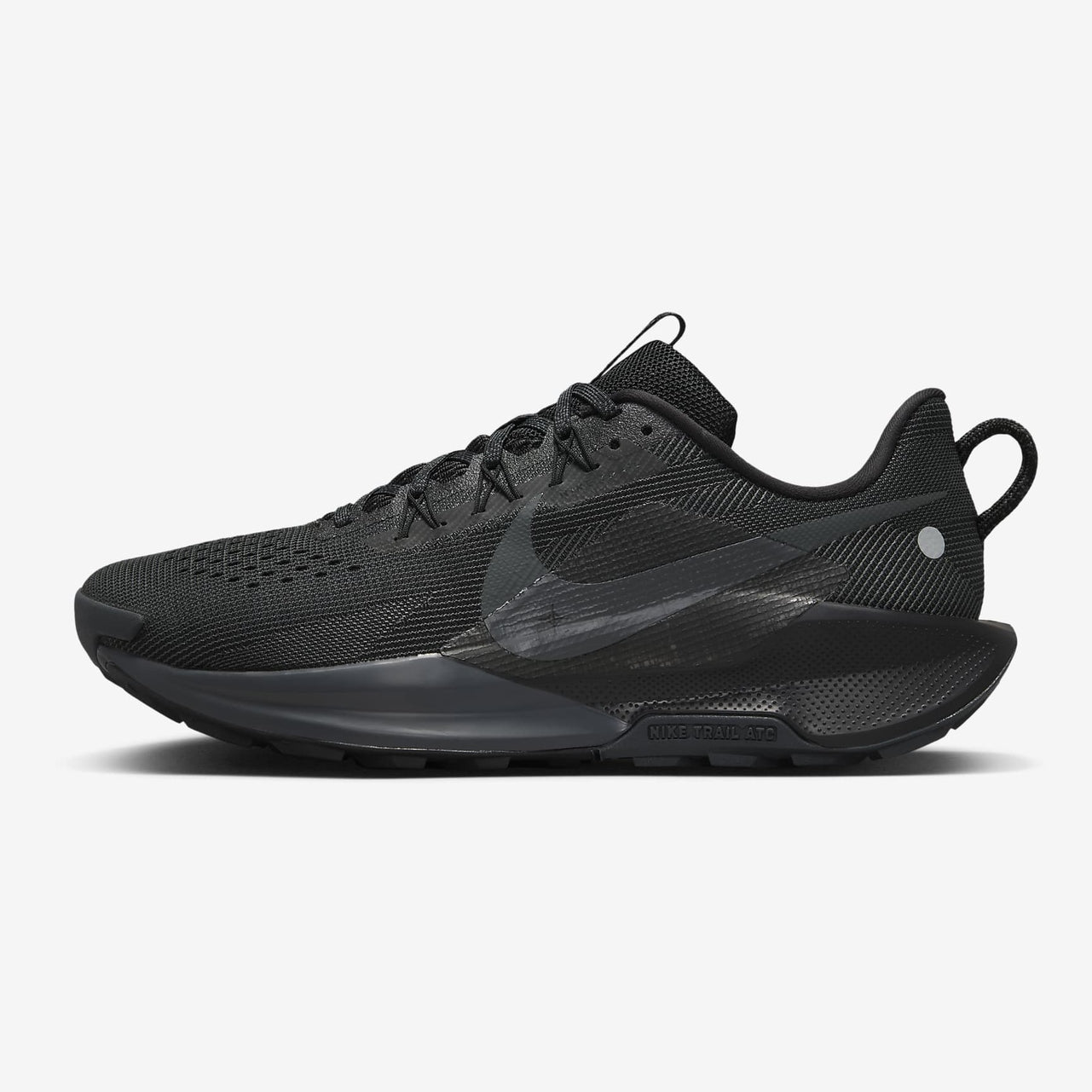
The central split
These are daily trainers with moderate geometry, yet they begin from opposite ends of a mixed route. Nike starts with familiar road-shoe cushioning and adds trail grip. adidas starts with a pronounced trail outsole and makes it approachable for everyday training. A runner could use either on forest paths, but the percentage of pavement and the roughness of dirt should decide the shortlist.
The current Nike is branded ACG Pegasus Trail and has a revised wider forefoot. The adidas comparison is specifically Agravic 3, not Agravic Speed, Speed Ultra, SL, or GTX. Marketplace naming can blur both families, so edition verification comes before price comparison.
Ride and cushioning
Nike uses ReactX foam and says the current Peg Trail carries more of it than before. The sensation is intended to be responsive and stable, with enough cushioning for scenic daily miles. The Agravic 3 uses a substantial but more conventional training platform; its family reserves the more dramatic race ride for Speed Ultra.
Both list 8 mm of heel-to-toe offset, which may ease transition for runners coming from traditional road trainers. Equal drop does not mean equal ride. Foam compression, stack, rocker, outsole stiffness, and toe-box shape alter how each shoe rolls. The Nike is the comfort-forward choice; adidas is the more grounded trail-workhorse selection.
Outsole and surface
The Agravic 3 specifies Continental rubber with 4 mm inner and 5 mm outer lugs. That makes its intention visible: bite into loose dirt and maintain support around the perimeter. Nike's All Terrain Compound is engineered for varied and wet trail contact, but its overall road-to-trail brief avoids the feel of a deep specialist tread.
Choose adidas for loose climbs, forest singletrack, rocky dirt, and routes that rarely touch asphalt. Choose Nike for park paths, hardpack, gravel, and runs that begin at home. Neither is a deep-mud specialist, and neither can guarantee wet-rock traction.
Continue this topic: adidas Terrex Agravic 3 Review: A Stable Daily Trail Shoe With Serious Lugs.
Fit and forefoot room
Nike explicitly redesigned the toe box and forefoot to add room. That gives the Pegasus an advantage for runners wanting toe movement without immediately selecting a wide. adidas calls the Agravic 3 regular fit and recommends the usual size on current US pages. The Terrex shape may feel more performance-oriented, but only a try-on can confirm it.
A wider shape is not the same as a labeled wide size. Check width availability, midfoot volume, heel hold, and descending security in both. If forefoot pressure appears in adidas, do not automatically add length; another width or shoe may be the better answer.
Technical terrain
The Agravic's deeper perimeter lugs and trail-centered build give it the advantage as terrain becomes looser and more consistently irregular. It is still an all-rounder, not a precision mountain shoe, but fewer compromises are made for pavement. Nike can handle moderately technical sections and says its wider forefoot adds stability; its sweet spot remains a route where rough features are occasional rather than continuous.
For prolonged off-camber rock, compare both with the Bushido III. For adhesive mud, compare a Speedcross. The winner here depends on whether “technical” describes ten minutes of a mixed run or nearly the entire outing.
Long runs and rotations
Nike's smoother cushioning can be attractive on long mixed-surface days, especially when fatigue includes pavement impact. adidas may feel more reassuring when long duration also means sustained loose trail. Neither replaces a max-cushion model for runners who want a deeply plush platform.
In a rotation, the Pegasus can handle easy door-to-trail days while the Agravic takes dirt-focused training. Owning both is unnecessary if routes overlap heavily. Select the shoe that covers the majority surface, then add a specialist only when mud, racing, or mountain precision creates a recurring gap.
Wet weather and version traps
The standard versions use breathable uppers. Nike and adidas each offer waterproof relatives, but those should be chosen for cold shallow wetness rather than assumed to be universal upgrades. Membranes run warmer and drain more slowly after water enters the collar.
Retailer search results may include Pegasus Trail 5, ACG Pegasus Trail, Agravic Speed Ultra or Agravic SL. These are distinct models; confirm the exact name before buying. The commerce targets state these relationships openly. Compare the edition on the listing with the edition discussed here.
People also ask
Questions that extend this decision
Which is better for mostly pavement and gravel?
The Nike Pegasus Trail is the stronger fit because its cushioning and outsole are designed around mixed road-to-trail use. The Agravic 3 can cross pavement but devotes more of its design to dirt.
Which shoe has deeper lugs?
adidas lists 4 mm inner and 5 mm outer lugs for the Agravic 3. Nike emphasizes its All Terrain Compound rather than positioning the Pegasus as an aggressive soft-ground design.
Do both shoes have the same drop?
Current official pages list 8 mm for both. Their rides still differ because cushioning, outsole geometry, platform dimensions, and upper fit are not the same.
Which has more toe room?
Nike explicitly says the current ACG Pegasus Trail has a redesigned wider toe box and forefoot. Individual shape remains decisive, and neither description guarantees a labeled wide size.
Which should a beginner choose?
A beginner on mixed urban trails will likely find the Nike more familiar; someone running primarily dirt may get more useful traction from adidas. Fit and usual terrain matter more than experience level.